
Stamp Duty Self-Assessment Malaysia: Property Transfers 2027
Stamp Duty Self-Assessment Malaysia: Property Transfers 2027
From 1 January 2027 property transfers that do not involve a JPPH valuation move to LHDN’s Stamp Duty Self-Assessment System. Here is what changes and how stamping on MyTax works.
By FinDoctor Malaysia · Last updated
Content
Stamp Duty Self-Assessment Malaysia: Property Transfers 2027
Quick answer: From 1 January 2027, transfers of real property that do not involve a JPPH valuation move to LHDN’s Stamp Duty Self-Assessment System (STSDS). The duty payer, or an appointed agent such as a lawyer, submits the STSDS return with the transfer instrument on MyTax and self-assesses the duty. The return is deemed assessed on submission, so payment can be made straight away without waiting for an LHDN assessment notice. Transfers that involve a JPPH valuation are not in Phase 2.
What is STSDS, and when does Phase 2 start?
STSDS (Sistem Taksir Sendiri Duti Setem) is LHDN’s Stamp Duty Self-Assessment System. It is being introduced in phases based on the type of instrument, starting 1 January 2026. Under the older formal assessment route, LHDN assesses the instrument and issues an assessment notice before you pay. Under STSDS, the declaration you submit is deemed to have been assessed by the Collector at the time it is submitted to LHDN.
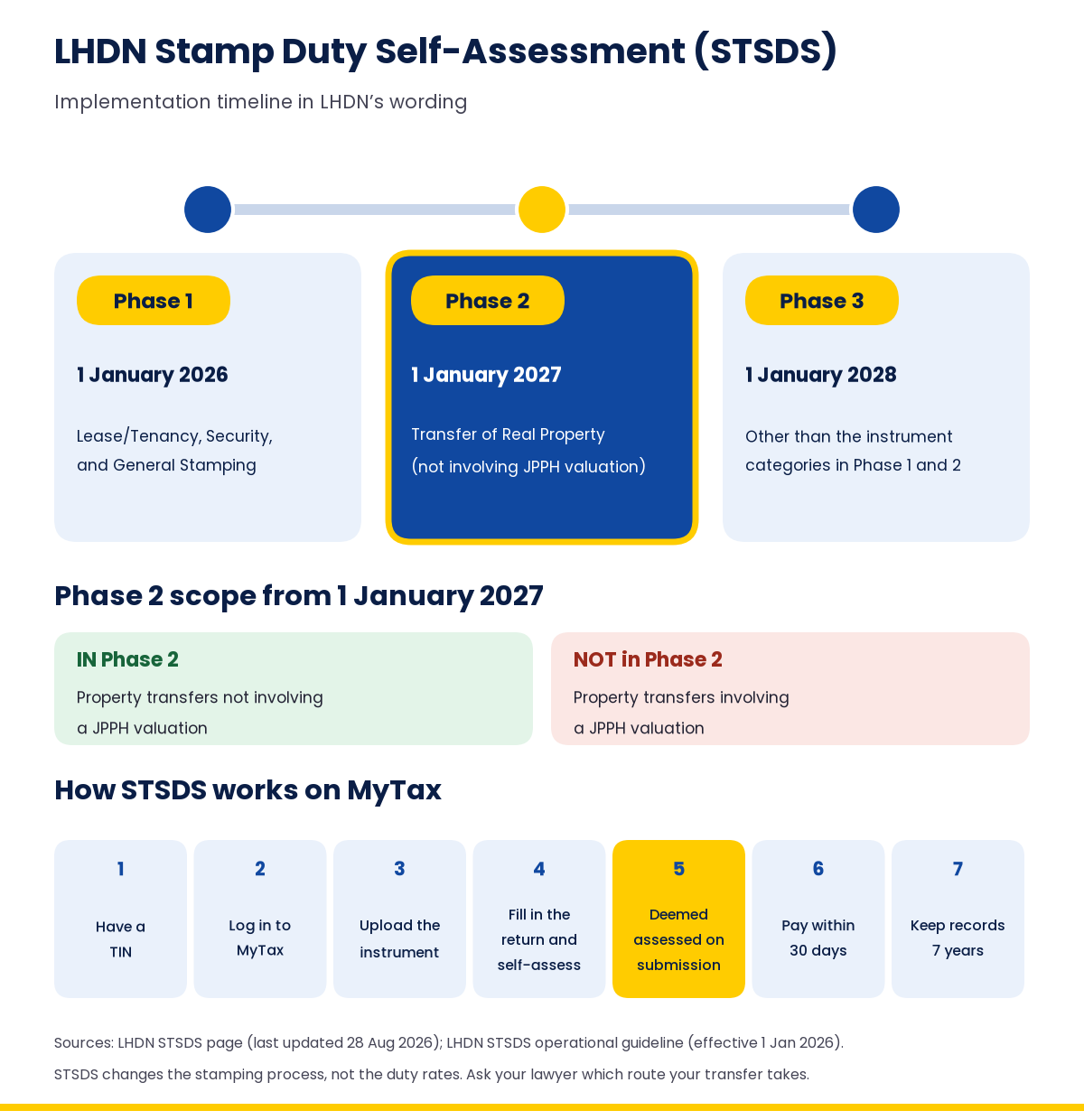
LHDN’s implementation timeline, in its own wording:
| Phase | Implementation date | Instruments covered (LHDN wording) |
|---|---|---|
| Phase 1 | 1 January 2026 | Lease/Tenancy, Security, and General Stamping |
| Phase 2 | 1 January 2027 | Transfer of Real Property (not involving JPPH valuation) |
| Phase 3 | 1 January 2028 | Other than the instrument categories in Phase 1 and 2 |
Which property transfers are in Phase 2, and which are not?
In Phase 2: transfers of real property that do not involve a valuation by JPPH (Jabatan Penilaian dan Perkhidmatan Harta, the Valuation and Property Services Department).
Not in Phase 2: transfers of real property that involve a JPPH valuation. Not every property transfer moves to self-assessment on 1 January 2027. Going by LHDN’s wording, these transfers fall under Phase 3, “Other than the instrument categories in Phase 1 and 2”, from 1 January 2028.
LHDN’s operational guideline says instrument types in Phases 2 and 3 keep formal assessment until STSDS is implemented for them. LHDN’s STSDS page does not list which transfers involve a JPPH valuation, so ask your lawyer which route your transfer will take.
How do you stamp a property transfer on MyTax under STSDS?
LHDN says the duty payer or appointed agent needs to:
- Have a Tax Identification Number (TIN). If you do not have one, LHDN’s guideline says you can check or register through e-Daftar on MyTax.
- Log in via the MyTax portal and use e-Duti Setem.
- Upload the instrument to be stamped. For a property transfer, LHDN’s guideline gives Form 14A as the instrument, with the sale and purchase agreement and the title as supporting documents.
- Fill in the STSDS return form.
- Self-assess the stamp duty payable on the instrument.
- Pay within the stipulated period. The return is deemed assessed on the day it is submitted, and LHDN’s guideline says payment is due within 30 days of that date.
- Keep the instrument and all related records for 7 years from the date the duty was paid.
Timing: LHDN’s guideline says an instrument signed in Malaysia must be submitted within 30 days of the date it is signed, under section 47 of the Stamp Act 1949. Late stamping attracts a penalty under section 47A, at the rates on LHDN’s stamp duty penalty page.
Does STSDS change how much stamp duty you pay?
STSDS changes the process, not the duty rates. Stamp duty on a property transfer is still charged under the First Schedule of the Stamp Act 1949. What changes is who works out the figure and when it is treated as assessed. If a return has an error, LHDN’s guideline lets the duty payer apply to amend it.
First-home stamp duty relief is a separate measure. For the Budget 2027 proposal and who qualifies, read our guide to Budget 2027 stamp duty relief for first homes.
Is the Finance Bill 2026 involved? The Finance Bill 2026, which amends the Stamp Act 1949 among other laws, was tabled for first reading in the Dewan Rakyat on 16 November 2026. It becomes law only after it is passed and gazetted. LHDN’s STSDS guideline, effective 1 January 2026, already set Phase 2 for 1 January 2027.
What should buyers and sellers prepare before 1 January 2027?
- Check that you have a TIN. The duty payer or appointed agent needs one to use STSDS on MyTax.
- Ask your lawyer whether your transfer involves a JPPH valuation. That decides whether it is self-assessed under Phase 2 or stays on formal assessment.
- Diarise the dates. Note when the transfer instrument is signed and when the return is submitted, since both start a 30-day window.
- Estimate the duty early with the stamp duty, legal and valuation fee calculator.
- Keep your records. Store the stamped instrument, the stamp certificate and supporting documents for 7 years from the date the duty was paid.
For the wider buying process, see what first-time home buyers in Malaysia need to know and our guide to SPA, stamp duty and legal fees for a property purchase.
How FinDoctor helps
Work out your upfront costs with the stamp duty, legal and valuation fee calculator. Then get your free FinDoctor Lite Report to review your credit profile, and check your home loan eligibility across 20 Malaysian banks. FinDoctor is not a lender and does not guarantee approval, rates or amounts. Each bank makes its own decision.
Frequently asked questions
Does STSDS Phase 2 cover every property transfer?
No. Phase 2 covers only transfers of real property that do not involve a JPPH valuation. Transfers that involve a JPPH valuation are not in Phase 2.
Do I still need a lawyer to stamp my property transfer?
LHDN lets the duty payer or an appointed agent such as a lawyer submit the STSDS return on MyTax. LHDN advises duty payers to appoint a competent and qualified agent.
Does STSDS change the stamp duty rate on a property transfer?
No. STSDS changes how the duty is assessed and paid. The rates are still set by the Stamp Act 1949.
When must I pay after submitting the STSDS return?
The return is deemed assessed by the Collector on the day you submit it. LHDN’s STSDS guideline says the duty must be paid within 30 days of that date.
How long must I keep my stamping records?
Keep the stamped instrument and all related records for 7 years from the date the duty was paid.
Is the Finance Bill 2026 law yet?
No. It was tabled for first reading on 16 November 2026 and becomes law only after it is passed and gazetted. The Phase 2 start date comes from LHDN’s own STSDS timeline.
Sources
- LHDN, Stamp Duty Self-Assessment System (STSDS), last updated 28 August 2026
- LHDN, Garis Panduan Operasi: Permohonan Penyeteman melalui STSDS (operational guideline), effective 1 January 2026
- LHDN, Penalty (Stamp Duty) (accessed 24 November 2026)
- The Star, Finance Bill proposes higher personal tax relief, lower rates for small businesses, 16 November 2026
- Business Today, Two Finance Bills tabled for first reading, 16 November 2026
This article is general information, not legal or tax advice. Confirm how your transfer will be stamped with your lawyer.
Last updated: 24 November 2026

Apply Now to Get Started!
Get your personalised recommendations on which bank offers the best interest rates for you!
FinDoctor Money Tips

· FinDoc Editorial Team
Appoint Your Tax Agent in MyTax: Form CP55 Ends 1 Jan 2027
From 1 January 2027 you appoint and authorise a tax agent only in MyTax. Here’s how to answer LHDN’s offer before 31 January 2027 or appoint an agent yourself.

· FinDoc Editorial Team
SME SRF Loan 2026: Who Qualifies, Rates and 2027 SME Tax
BNM’s SME Stabilisation Relief Facility offers viable SMEs hit by the Middle East conflict up to RM750,000 in working capital at up to 3.75% a year with no collateral until 30 June 2027. Here is who qualifies, how to apply and what the Budget 2027 SME tax proposals mean.