
Self-Employed Home Loan Malaysia: Documents, Income and DSR
Self-Employed Home Loan Malaysia: Documents, Income and DSR
Banks rebuild self-employed income from bank statements, Form B and SSM records before applying DSR. Here is what to prepare, how income is assessed and when SJKP may help a first home.
By FinDoctor Malaysia · Last updated
Content
Self-Employed Home Loan Malaysia: Documents, Income and DSR
Quick answer: Self-employed people in Malaysia can get a home loan but banks rebuild their income from documents instead of a payslip. Expect to show about 6 months of personal and business bank statements, your latest LHDN Form B with the tax payment receipt and your SSM business registration. Many banks then count only part of variable or business income before applying their debt service ratio (DSR) limit, so the loan you qualify for can be smaller than your headline revenue suggests and it differs bank by bank.
Can self-employed people get a home loan in Malaysia?
Yes. Freelancers, gig workers, sole proprietors, partners and company owners all apply for home loans in Malaysia. The difference is how income is proven. A salaried applicant shows payslips and EPF statements. A self-employed applicant has to show that income through bank statements, tax filings and business records.
Since 1 January 2012 Bank Negara Malaysia’s responsible financing guidelines have required banks to assess affordability using a prudent DSR. Banks must look at income after statutory deductions for tax and EPF and consider all debt obligations. Bank Negara Malaysia has also reported that banks strengthened their documentation requirements for verifying income and used more conservative assumptions to estimate variable income. That is why self-employed applications usually need more paperwork.
What documents do banks ask self-employed applicants for?
Each bank sets its own list, but most ask for the same core set. The table shows what is commonly requested for each type of self-employed applicant.
| Applicant type | Income proof commonly requested | Business proof commonly requested |
|---|---|---|
| Sole proprietor or partner | About 6 months of personal and business bank statements; latest Form B with the tax payment receipt | SSM business registration certificate; partnership agreement if any |
| Sdn Bhd owner or director | Personal bank statements; personal tax return; salary or director’s fee records | SSM company records; company financial statements; company bank statements |
| Freelancer or gig worker without a registered business | About 6 months of bank statements showing regular income; latest Form B with the tax payment receipt | Platform payout records or client invoices may support the statements |
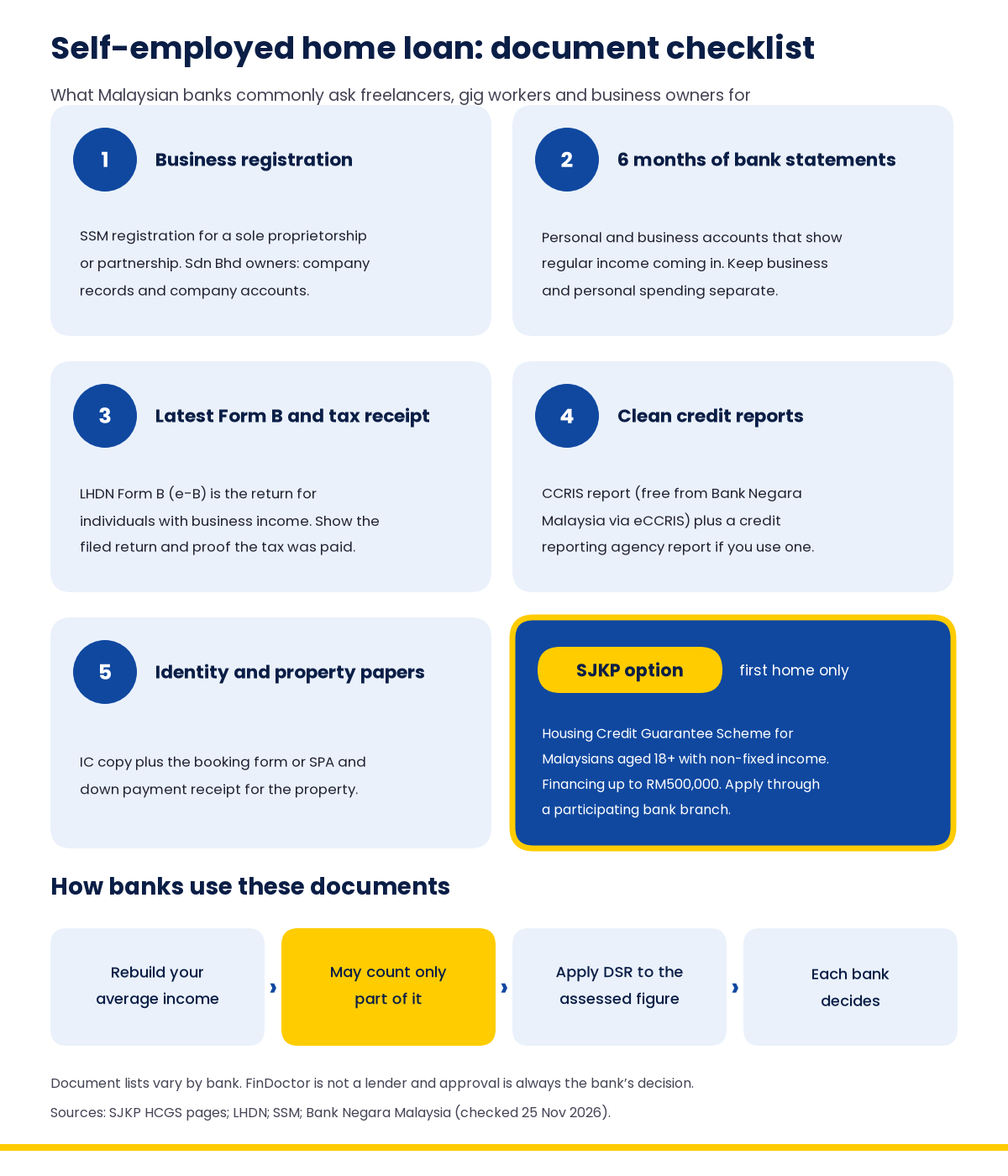
Every applicant also needs an IC copy and the property papers, such as the booking form or Sale and Purchase Agreement and the down payment receipt. Banks will also check your CCRIS record, which you can get free of charge from Bank Negara Malaysia through eCCRIS.
Form B and SSM in plain terms
Form B (e-B) is LHDN’s income tax return for resident individuals who carry on a business, including sole proprietors, partners and people earning from a profession or vocation. Employment-only earners file Form BE instead. LHDN’s deadline for Form B is 30 June each year, with e-Filing (e-B) accepted until 15 July. Filing on time and paying the tax gives a bank an official record of your business income.
SSM registration is how a sole proprietorship or partnership is registered under the Registration of Businesses Act 1956. SSM says a business must be registered within 30 days of starting. A partnership has two to 20 owners. A Sdn Bhd is a company, so its records come from SSM’s company registry instead.
How do banks assess self-employed income?
Banks generally rebuild your income in three steps:
- Average it. They look at deposits over the statement period and the profit declared in your Form B to estimate a monthly figure.
- Recognise part of it. Many banks apply an income recognition percentage, often called a haircut, to variable or business income. The percentage is set by each bank and is not published by Bank Negara Malaysia.
- Apply DSR. The bank then divides your total monthly commitments, including the new home loan instalment, by the income it has recognised.
This is why two applicants with the same headline revenue can get very different results. Large deposits that are later paid out to suppliers, transfers between your own accounts and one-off payments may not count as income. Clean records that separate business and personal money make the rebuild simpler.
How does DSR work for self-employed borrowers?
DSR (debt service ratio) is your total monthly debt repayments divided by your monthly net income. For a self-employed applicant the income side is the figure the bank has assessed, not your gross revenue.
Illustration only, not any bank’s policy: Aina is a freelance designer. Her documents support average net income of RM8,000 a month. She has existing commitments of RM1,200 a month and the new home loan instalment would be RM2,000.
| If a bank counts all RM8,000 | If a bank recognises RM6,000 | |
|---|---|---|
| Total monthly commitments | RM3,200 | RM3,200 |
| Income used | RM8,000 | RM6,000 |
| DSR | 40% | About 53% |
The same application looks very different depending on how much income a bank recognises and where it sets its own DSR limit. You can test your own numbers with the home loan eligibility and DSR calculator.
Can a self-employed or gig worker use SJKP for a first home?
Possibly. Syarikat Jaminan Kredit Perumahan (SJKP) runs the Housing Credit Guarantee Scheme (HCGS). SJKP guarantees the financing to the participating bank. It does not approve the loan itself, and the bank still makes the credit decision. SJKP’s published criteria, checked on 25 November 2026:
| Criterion | What SJKP states |
|---|---|
| Who | Malaysian citizens aged 18 and above; joint financing is allowed |
| Income type | Non-fixed income earners or self-employed (a fixed income category also exists) |
| Property | Purchase of a first new house, sub-sale house or auctioned house to be owner-occupied; residential only |
| HCGS financing limit | Up to RM500,000 including the principal, MRTA or MRTT, LTHO, solicitor’s fee and valuation fee |
| HCGS-MADANI financing limit | Up to RM360,000 including up to 100% of the purchase price and listed costs |
| Tenure | Up to 35 years or the loan tenure, whichever is earlier; two-generation financing allowed |
| Commitments | Total repayment of all the applicant’s loans does not exceed 65% of gross monthly income |
| Credit record | CCRIS arrears of not more than 2 months within 12 months and no other adverse credit records in the last 24 months |
SJKP says applications are made at a branch of a participating financial institution, not at the SJKP office, and that SJKP charges the borrower no fee. SJKP does not cover refinancing, building on your own land or shophouses. For applicants without formal records, SJKP’s document list includes a declaration letter on self-employment or income confirmed by a JKKK, a Category A government servant, a Penghulu or Ketua Kampung, or a bank branch manager. For more on first purchases, read our first-time home buyer guide.
How can self-employed applicants prepare before applying?
- File Form B on time and pay the tax. A filed return and payment receipt is official proof of income.
- Register the business. An SSM registration shows the income comes from a real business.
- Keep business and personal money apart. Use one business account so deposits are easy to trace.
- Check your credit reports first. Get your free CCRIS report and fix any errors. Our guide to comparing credit score reports explains what each report shows.
- Reduce commitments. Settling small debts lowers the commitment side of DSR.
- Avoid many applications at once. Each application appears in CCRIS, so shortlist banks before you apply.
- Consider a joint applicant. SJKP allows joint applications, and many banks accept a co-borrower with steady income.
Our step-by-step guide to applying for a home loan in Malaysia covers the rest of the process.
Which bank is best for a self-employed home loan?
No bank is simply “easier” for self-employed applicants, and no bank can promise approval in advance. Banks differ in which documents they accept, how much variable income they recognise and where they set DSR limits. That is why comparing policies across 20 Malaysian banks helps you see which lenders fit your documentation and income structure before you apply. Get your free Lite Report to see which of 20 Malaysian banks may assess your income type.
How FinDoctor helps
Start with the free FinDoctor Lite Report. It shows which of 20 Malaysian banks may assess your type of self-employed or non-fixed income, so you can shortlist lenders before you apply instead of sending many applications. Get your free Lite Report.
- Lite Report (free): a first look at how your profile fits across 20 Malaysian banks.
- Pro Report (RM50): the more detailed paid report. Get the Pro Report.
- Pro Advisory (RM650): the Pro Report plus a 45-minute one-on-one online session with a credit expert, including advice on reducing commitments. Book Pro Advisory.
As a supporting tool, use the home loan eligibility and DSR calculator to test different income and commitment figures. You can also browse home loan options. FinDoctor is not a lender and does not guarantee approval; approval is always the bank’s decision.
Frequently asked questions
Can I get a home loan in Malaysia if I am self-employed?
Yes. Banks lend to self-employed applicants but they ask for more income proof such as bank statements and Form B with the tax receipt. Approval is always the bank’s decision.
How many months of bank statements do self-employed applicants need?
About 6 months is a common starting point and SJKP lists the latest 6 months of bank statements. Some banks may ask for more so confirm the list with each bank.
Do banks count all of my business income?
Not always. Many banks rebuild your income from your documents and may recognise only part of variable or business income before they apply DSR. The approach differs from bank to bank.
Can a freelancer or gig worker use SJKP?
Possibly. SJKP’s Housing Credit Guarantee Scheme is open to Malaysians aged 18 and above with non-fixed income who are buying a first home to live in. You apply through a participating bank branch and not at the SJKP office.
Does FinDoctor approve home loans?
No. FinDoctor is not a lender and does not guarantee approval. The free Lite Report helps you see how your profile fits across 20 Malaysian banks before you apply.
Sources
- SJKP, HCGS Eligibility, HCGS scheme features, HCGS-MADANI, Documents required by financial institutions and FAQ (accessed 25 November 2026)
- LHDN, Reporting period (Tempoh Melapor), last updated 13 May 2026
- LHDN, Return Form Filing Programme for the Year 2026
- SSM, Starting a Sole Proprietorship or Partnership and SSM Compendium (accessed 25 November 2026)
- Bank Negara Malaysia, Measures to Promote Responsible Financing Practices, 18 November 2011
- Bank Negara Malaysia, Financial Stability and Payment Systems Report 2013
- Bank Negara Malaysia, CCRIS (accessed 25 November 2026)
This article is general information, not financial advice. Bank document lists and policies change, so confirm requirements with each bank before you apply.
Last updated: 25 November 2026

Apply Now to Get Started!
Get your personalised recommendations on which bank offers the best interest rates for you!
FinDoctor Money Tips

· FinDoc Editorial Team
How to Calculate DSR in Malaysia and How to Reduce It
Malaysian banks divide your monthly debt repayments by your net income. Here’s the formula, what counts as a commitment, a worked RM example and how to lower your DSR before you apply.

· FinDoc Editorial Team
Personal Loan Flat Rate Malaysia 2027: BNM Rules and Top-Ups
From 1 January 2027 banks can’t offer flat rate or Rule of 78 personal loans and some home loan top-ups count as personal financing. Here’s what changes and what’s already in force.
· FinDoc Editorial Team
Stamp Duty Self-Assessment Malaysia: Property Transfers 2027
From 1 January 2027 property transfers that do not involve a JPPH valuation move to LHDN’s Stamp Duty Self-Assessment System. Here is what changes and how stamping on MyTax works.