How to Calculate DSR in Malaysia and How to Reduce It
Quick answer: DSR (debt service ratio) = (total monthly debt commitments ÷ net monthly income) × 100%. Malaysian banks use net income, meaning your pay after tax, EPF and SOCSO, and they add the instalment of the loan you are applying for to your existing repayments. Bank Negara Malaysia does not set one DSR limit for every borrower; each bank sets its own prudent level, so the same payslip can get different answers from different banks.
What is the DSR formula in Malaysia?
DSR = (total monthly debt commitments ÷ net monthly income) × 100%
Bank Negara Malaysia (BNM) defines the debt service ratio as the “ratio of total monthly bank and non-bank debt obligations to monthly net income (net of statutory deductions)”. Under BNM’s responsible financing rules, banks must assess whether you can afford a new loan using a prudent DSR, counting all your debt repayment obligations from banks and non-banks against your income after statutory deductions for tax, EPF and SOCSO.
Two points matter most:
- The new loan counts. Banks add the monthly instalment of the loan you are applying for to the repayments you already make.
- Non-bank debt counts. BNM’s definition covers debt owed to banks and non-banks, not just bank loans.
FinDoctor’s Home Loan Eligibility and DSR Calculator uses the same formula: DSR = total commitment ÷ net income × 100%, where total commitment includes your existing loans, credit cards, overdrafts, share margin financing and the loan you are applying for.
Does DSR use net or gross income?
Net income. BNM notes: “In Malaysia, DSRs are computed using net income while in other countries such as the UK and Singapore, DSRs are computed using gross or pre-tax incomes.” Net income is your gross monthly income minus tax and statutory contributions such as EPF and SOCSO.
| Applicant | Income the FinDoctor calculator asks for |
|---|---|
| Employed | Net income as shown on your payslips (gross income minus tax, EPF and SOCSO) |
| Self-employed | Yearly declared taxable income minus tax payable (divide by 12 for a monthly figure) |
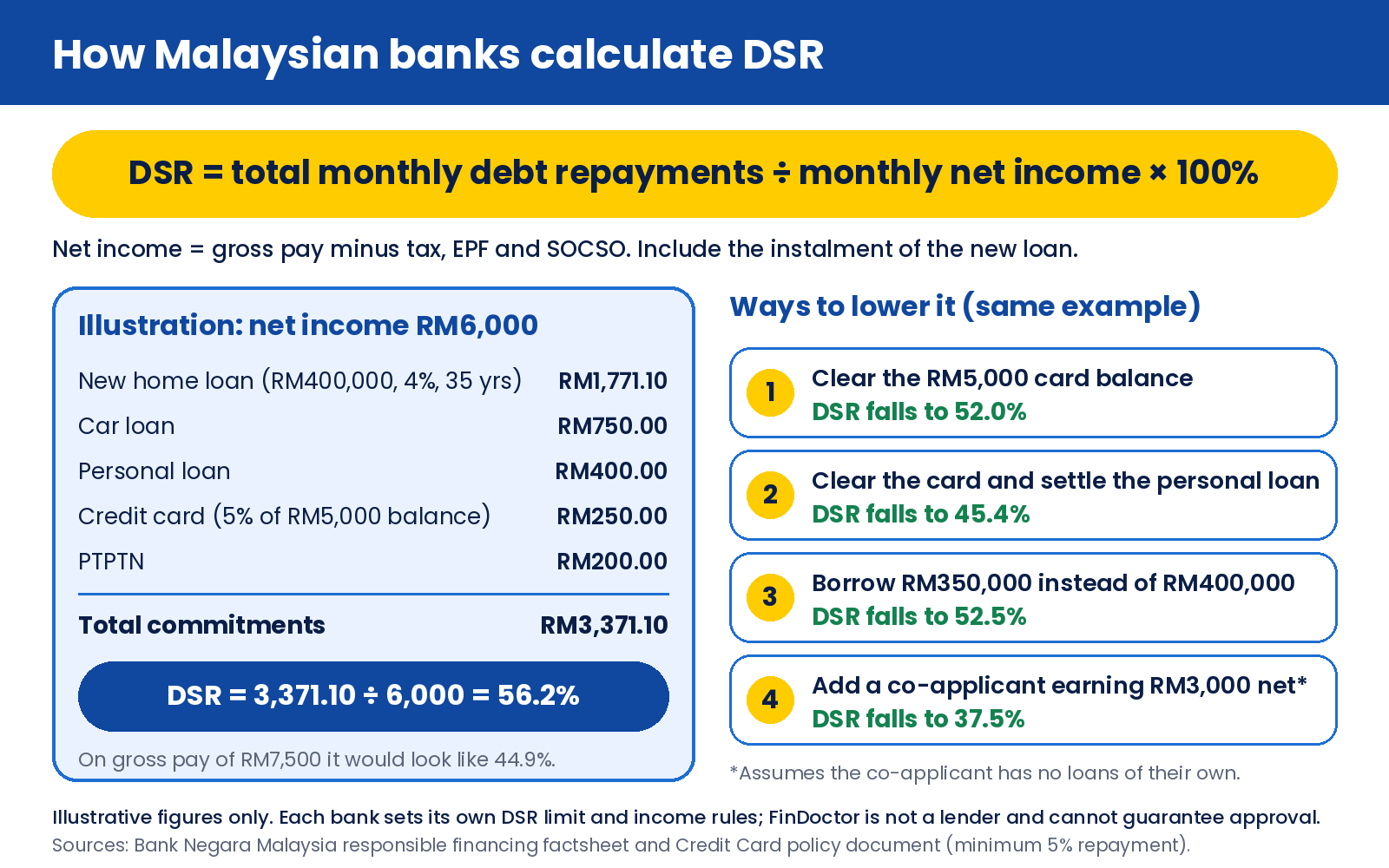
Using gross income makes your DSR look lower than a bank will see it. In the illustration below, the same commitments give a DSR of 56.2% on net income of RM6,000 but only 44.9% on gross income of RM7,500.
What counts as a monthly commitment in DSR?
| Usually counted as a commitment | Not part of the DSR formula itself |
|---|---|
| Home loan instalments, including the new loan you are applying for | Utility, phone and internet bills |
| Car loan (hire purchase) instalments | Groceries, transport and other living costs |
| Personal loans and other term loans, including loans from non-banks | Rent you pay as a tenant |
| PTPTN repayments and ASB financing instalments | Insurance or takaful premiums you pay in cash (a premium financed into a loan becomes part of that loan’s instalment) |
| Credit cards, overdrafts and share margin financing | Savings and investments you choose to make |
| Buy now pay later (BNPL) instalments |
Credit cards. Each lender decides how to turn card balances into a monthly figure, so ask yours. The FinDoctor calculator asks for your total outstanding credit card balance rather than what you paid last month. For reference, BNM requires card issuers to set a minimum monthly repayment of at least 5% of the total amount outstanding, plus any easy payment plan or balance transfer plan instalments.
BNPL. BNM requires a lender to carry out a DSR-based affordability assessment before granting a new BNPL facility when your total BNPL credit limits reach RM1,500 or more, so BNPL is treated as debt.
Living costs still matter. Bills and groceries are not in the DSR formula, but BNM expects banks to check that your net income can cover “expenditure on necessities and all other obligations” as well as your repayments. Banks also look at how much money you have left each month after repayments, alongside DSR.
How do you calculate DSR step by step?
This is an illustration only. Your bank’s figures, interest rate and treatment of each commitment may differ.
Aina’s payslip shows gross income of RM7,500 and net income of RM6,000. She is applying for a RM400,000 home loan over 35 years. At 4% a year, the indicative mortgage rate the FinDoctor calculator displays, the instalment works out to RM1,771.10 a month. This is not a rate offer.
| Monthly commitment | Amount |
|---|---|
| New home loan (RM400,000, 4%, 35 years) | RM1,771.10 |
| Car loan | RM750.00 |
| Personal loan | RM400.00 |
| Credit card (5% of a RM5,000 outstanding balance, used here as an assumption) | RM250.00 |
| PTPTN | RM200.00 |
| Total commitments | RM3,371.10 |
- Add up the commitments: RM1,771.10 + RM750.00 + RM400.00 + RM250.00 + RM200.00 = RM3,371.10.
- Divide by net income: RM3,371.10 ÷ RM6,000 = 0.56185.
- Multiply by 100: DSR = 56.2%.
Before the new home loan, Aina’s existing commitments of RM1,600.00 give a DSR of 26.7%. The new instalment is what pushes her DSR above 50%.
What DSR do Malaysian banks accept?
There is no single figure. BNM requires each financial institution to set its own prudent DSR level, one that prevents customers from becoming over-indebted and leaves enough buffer for daily and essential spending and emergencies, having regard to each customer’s circumstances. BNM does not publish one DSR cap that applies to all home loans.
That is why acceptable DSR levels differ by bank, by income level, by loan type and by applicant, and why one bank may approve an application that another declines. Treat any single “maximum DSR” you read online as a rough guide, not a rule.
One BNM reference point is useful context. In its stress tests, BNM refers to borrowers with a DSR above 60% as high-DSR borrowers and found they were up to 5.5 times more likely to default under severe unemployment and income shocks than borrowers below 60%. That is a risk measure, not a bank’s approval cutoff.
How do banks treat variable, self-employed and joint income?
- Bonuses, commission, overtime and allowances. Each bank sets its own rules on how much variable income it recognises. Some may count only part of it or average it over a period, so your assessed income can be lower than your best month.
- Rental income. Banks set their own policies here too and usually want evidence such as tenancy agreements and bank statements showing the rent coming in.
- Self-employed income. Banks rely on documented income. The FinDoctor calculator uses yearly declared taxable income minus tax payable, so income that is not declared does not help your DSR.
- Joint applications. A bank may combine both applicants’ net incomes and both sets of commitments. In the illustration, adding a co-applicant with RM3,000 net income and no loans of their own lowers the DSR from 56.2% to 37.5%. Each bank decides how it assesses joint applicants.
How can I reduce my DSR before applying?
Every ringgit of monthly commitment you remove, or every ringgit of documented net income you add, lowers your DSR. Using the same illustration:
| Change (illustration) | Total commitments | DSR |
|---|---|---|
| Starting point | RM3,371.10 | 56.2% |
| Clear the RM5,000 credit card balance | RM3,121.10 | 52.0% |
| Clear the card and settle the personal loan | RM2,721.10 | 45.4% |
| Borrow RM350,000 instead of RM400,000 (instalment RM1,549.71) | RM3,149.71 | 52.5% |
| Add a co-applicant with RM3,000 net income and no loans | RM3,371.10 on RM9,000 | 37.5% |
- Clear revolving balances. Paying down credit card balances and overdrafts reduces the commitment a bank counts against you.
- Settle small loans fully. Fully settling a loan removes its instalment. A partial prepayment may only shorten the tenure without lowering the monthly instalment, so ask your lender how it is applied and whether early settlement charges apply.
- Pause new credit. Avoid new car loans, personal loans, cards or BNPL plans in the months before you apply, and close credit lines you no longer use.
- Size the loan realistically. A smaller loan or a bigger down payment lowers the new instalment. A longer tenure also lowers it, but costs more interest overall: in the illustration, a 30-year tenure means RM1,909.66 a month against RM1,771.10 over 35 years, yet the 35-year loan costs roughly RM56,000 more in total repayments. In 2016, BNM described 35 years as the maximum housing loan tenure.
- Document all your income. Keep payslips, EA forms, tax returns, bank statements and tenancy agreements ready so the bank can recognise as much of your income as its policy allows.
- Consider a joint application if a co-borrower with steady income and low commitments is buying with you.
- Check your credit reports for errors. Your CCRIS report is free from BNM through eCCRIS, where you can also submit a data verification request if a facility is wrong or already settled. Our guide on how to improve your credit score in Malaysia explains what else lenders look at.
If you are juggling several high-interest debts, our debt consolidation guide explains when combining them into one loan can lower your monthly repayments, and what it can cost.
A lower DSR improves how your application looks, but it does not guarantee a bigger loan or approval. Banks also look at your credit history, employment, the property and their own policies.
How FinDoctor helps
Get your free Lite Report to see how your credit profile fits across 20 Malaysian banks before you apply. For a deeper review, the Pro Report costs RM50 and Pro Advisory costs RM650; get either report at findoctor.my/report, or book Pro Advisory.
You can also run your own numbers in the Home Loan Eligibility and DSR Calculator, which uses net income and includes your new instalment, or explore home loan options.
FinDoctor is not a lender and does not guarantee approval, rates, DSR limits or loan amounts. Approval is always the bank’s decision.
Frequently asked questions
Does DSR use net or gross income in Malaysia?
Net income. Bank Negara Malaysia defines DSR as monthly debt obligations divided by monthly income after statutory deductions such as tax and EPF and SOCSO.
What DSR do Malaysian banks accept?
There is no single figure. Bank Negara Malaysia requires each lender to set its own prudent DSR level so the acceptable DSR differs by bank and by applicant. FinDoctor does not guarantee any DSR limit or approval.
Does the new home loan instalment count in my DSR?
Yes. Banks add the monthly instalment of the loan you are applying for to your existing commitments before they work out your DSR.
How are credit cards counted in DSR?
Each lender decides how to count card balances. The FinDoctor calculator asks for your total outstanding balance and card issuers must set a minimum monthly repayment of at least 5% of the amount outstanding.
Do utility bills and insurance count in DSR?
No. DSR only counts debt repayments. Banks still check that your income covers living costs and a premium financed into a loan counts as part of that loan.
What is the fastest way to lower my DSR?
Clear revolving balances and settle small loans before you apply and avoid taking on new credit. Each ringgit of monthly repayment you remove lowers your DSR.
Sources
- Bank Negara Malaysia, Financial Stability Review Second Half 2025, glossary (DSR definition): https://www.bnm.gov.my/documents/20124/21185035/%5BFSR+2H25%5D+_en_glossary.pdf
- Bank Negara Malaysia, Guidelines on Responsible Finance factsheet (24 February 2012): https://www.bnm.gov.my/documents/20124/65409/factsheet_20120224_en.pdf
- Bank Negara Malaysia, Measures to Promote Responsible Financing Practices (18 November 2011): https://www.bnm.gov.my/-/measures-to-promote-responsible-financing-practices
- Bank Negara Malaysia, Responsible lending guidelines ensures borrowers’ affordability (20 September 2016): https://www.bnm.gov.my/-/responsible-lending-guidelines-ensures-borrowers-affordability
- Bank Negara Malaysia, Financial Stability Review First Half 2024, Box Article: Looking Beyond DSR to Assess Households’ Debt-Servicing Capacity: https://www.bnm.gov.my/documents/20124/15829666/fsr24h1_en_box1.pdf
- Bank Negara Malaysia, Policy Document on Credit Card and Credit Card-i (19 December 2025), paragraph 13.1: https://www.bnm.gov.my/documents/20124/938039/credit_card_and_credit_card-i_PD.pdf
- Bank Negara Malaysia, Policy Document on Personal Financing (30 September 2025), paragraph 11.4: https://www.bnm.gov.my/documents/20124/938039/pd-pf-sep25.pdf
- Bank Negara Malaysia, CCRIS frequently asked questions: https://www.bnm.gov.my/faq/ccris
- FinDoctor, Home Loan Eligibility and DSR Calculator (formula, income definitions and inputs, accessed 25 November 2026): findoctor.my/calculator/home-loan-eligibility-dsr-calculator
Last updated: 25 November 2026