Open Finance Malaysia: What BNM’s New Rules Mean for You
Quick answer: Open finance lets you choose to share your bank, e-money and card transaction data held by one financial institution with another through a secure, standard platform. Under Bank Negara Malaysia’s (BNM) Open Finance Policy Document issued on 17 November 2026, the largest banks must start sharing individual customers’ data by 1 January 2028. Nothing is shared without your explicit consent, and you can revoke it at any time.
What is open finance in Malaysia?
BNM defines open finance as a framework for the permissioned sharing of customer information between a data provider and a data consumer in a secure, open, accessible, interoperable and timely manner. In plain terms, you can ask the institution that holds your data (the data provider) to send it to another institution you choose (the data consumer).
BNM’s Open Finance Policy Document (BNM/RH/PD 028-145) was issued on 17 November 2026. It applies to licensed banks, investment banks and Islamic banks, licensed insurers and takaful operators, prescribed development financial institutions (DFIs) and eligible e-money issuers.
Only some of these must take part. Participation is mandatory for banks and Islamic banks with more than 250,000 active individual and SME customers, prescribed DFIs above the same threshold, and eligible e-money issuers with more than 5 million active users. Investment banks, insurers and takaful operators are not mandated.
Open finance vs open banking: what’s the difference?
BNM’s policy document does not use the term “open banking”. The term is commonly used for sharing bank account data. BNM’s framework is called open finance because its scope goes beyond banks to include insurers, takaful operators, DFIs and e-money issuers. In the first phase, the data that must be shared covers deposit, e-money, charge card and credit card accounts.
When will open finance start?
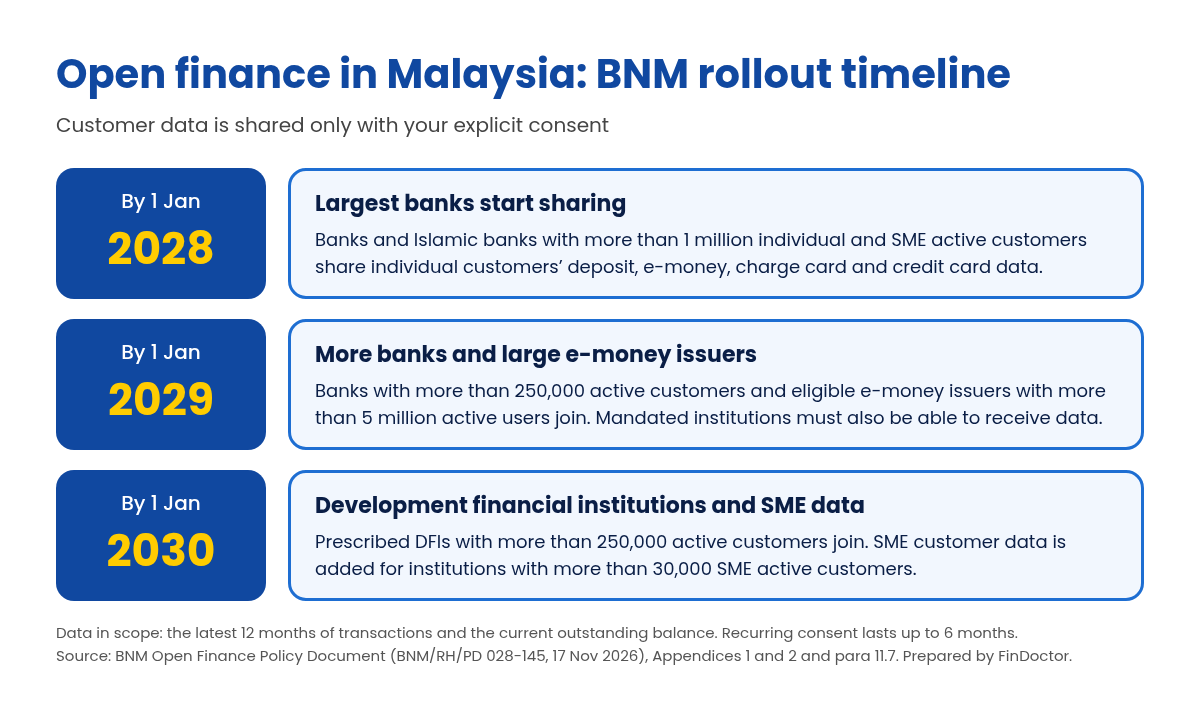
BNM is phasing it in over three years. Dates are the latest dates by which each group must comply.
| By | Who must share data (data provider) | What is shared |
|---|---|---|
| 1 January 2028 | Banks and Islamic banks with more than 1 million individual and SME active customers (entity or banking group level) | Individual customers’ deposit, e-money, charge card and credit card account and transaction information |
| 1 January 2029 | Banks and Islamic banks with more than 250,000 active customers, and eligible e-money issuers with more than 5 million active users | Same individual customer data |
| 1 January 2030 | Prescribed DFIs with more than 250,000 active customers | SME customer data is added for institutions with more than 30,000 SME active customers |
Mandated institutions must also be able to receive data as a data consumer. That obligation starts by 1 January 2029 for banks and eligible e-money issuers, and by 1 January 2030 for DFIs.
What data can be shared, and how does consent work?
A mandated institution must share, with your consent:
- Transaction information for the most recent 12 months, including date, time, amount, currency, description and debit or credit indicator
- The current outstanding balance of the account
Institutions may share more on a voluntary basis, but only with your explicit consent. BNM sets these consent rules:
| Rule | What it means for you | Paragraph |
|---|---|---|
| Explicit consent | You must take an active step to agree. Silence and pre-ticked boxes do not count, and consent cannot be bundled with marketing. | 11.1 |
| Consent dashboard | You can view all active and past consents, see what is shared and why, and revoke consent at any time | 11.2 to 11.4 |
| One-time consent | Used once only and expires as soon as the data is retrieved | 11.6 |
| Recurring consent | Valid for no longer than six months from the date given, unless you revoke it earlier | 11.7 |
| Access logs | Institutions must show you when and by whom your information was accessed | 11.19 |
| Fees | Any fees must be fair and transparent and must not create unreasonable barriers | 12.21 |
Could open finance make loan applications easier?
Possibly, over time. BNM lists illustrative use cases, including:
- Credit underwriting through “real-time and accurate financial information”
- Fully digital submission of documents instead of manual processes such as email and web forms
- A single view of your accounts across institutions
Mandated institutions must also offer a digital document submission interface and a single account view. If you agree, a lender could retrieve your transaction data directly instead of asking you to upload statements. BNM stresses that these use cases are illustrative only and are not an endorsement. Open finance does not change how a bank decides, and approval always stays with the bank.
How can I prepare today?
- Keep your account conduct clean. If you share 12 months of transactions with a lender, bounced payments and missed instalments may show.
- Keep statements in order. Until open finance reaches your bank, you will still submit documents the usual way.
- Check your CCRIS report. Make sure your repayment record is accurate before you apply for credit.
- Read consent screens carefully. Agree only to the data and purpose you need, and check your consent dashboard from time to time.
How FinDoctor helps
You don’t need to wait until 2028 to see how banks might view your finances. FinDoctor’s free Lite Report checks your credit profile against 20 Malaysian banks today. To understand the tools behind it, read about AI loan checks with FinDoctor, how credit score reports compare, and how freelancers can prepare for a loan. For a deeper review, the Pro Report costs RM50 and Pro Advisory costs RM650.
FinDoctor is not a lender and does not guarantee approval. Approval is always the bank’s decision.
Frequently asked questions
Is open finance mandatory for customers?
No. Your information is shared only after you give explicit consent and you can choose not to share it.
When does open finance start in Malaysia?
The largest banks must start sharing individual customers’ data by 1 January 2028. More banks and large e-money issuers follow by 1 January 2029 and DFIs by 1 January 2030.
How long does open finance consent last?
Consent for recurring access lasts no longer than six months unless you revoke it earlier. One-time consent ends as soon as the data is retrieved.
Can I revoke my consent?
Yes. Participating institutions must give you a consent dashboard where you can revoke consent at any time.
What data can be shared?
The most recent 12 months of transactions and the current outstanding balance of your deposit or e-money or card account.
Sources
- Bank Negara Malaysia, Open Finance Policy Document (BNM/RH/PD 028-145), 17 November 2026: https://www.bnm.gov.my/documents/20124/938039/pd-openfinance-nov26.pdf
- The Star (Bernama), BNM establishes regulatory framework for open finance, 17 November 2026: https://www.thestar.com.my/business/business-news/2026/11/17/bnm-establishes-regulatory-framework-for-open-finance
Last updated: 20 November 2026