
Malaysia Housing Loan Approval Rate 2026: Why It’s Falling
Malaysia Housing Loan Approval Rate 2026: Why It’s Falling
BNM data shows Malaysian banks approved about 38% of the value of residential property loans applied for in January to September 2026, down from about 41% a year earlier. Here is what the approval ratio means and how to check your readiness before you apply.
By FinDoctor Malaysia · Last updated
Content
Malaysia Housing Loan Approval Rate 2026: Why It’s Falling
Quick answer: Between January and September 2026, Malaysian banks approved about 38% of the value of residential property loans applied for, based on Bank Negara Malaysia (BNM) data, down from about 41% in the same period of 2025. Approval depends on each bank’s view of your income, debt service ratio (DSR) and credit record, so check all three before you apply.
What is the housing loan approval rate in Malaysia in 2026?
BNM data shows Malaysian banks approved RM139.4 billion of the RM363.4 billion in residential loans applied for in January to September 2026, roughly 38%. That is below the 40 to 42% seen in 2022 to 2025.
We calculated this approval ratio by value from BNM’s monthly tables of loans applied for (Table 1.10) and loans approved (Table 1.12) for the purchase of residential property across the banking system.
| Year | Applied (Jan to Sep) | Approved (Jan to Sep) | Approval ratio (Jan to Sep) | Approval ratio (full year) |
|---|---|---|---|---|
| 2022 | RM348.2bn | RM139.3bn | 40.0% | 40.1% |
| 2023 | RM337.2bn | RM141.7bn | 42.0% | 41.6% |
| 2024 | RM346.8bn | RM146.3bn | 42.2% | 42.1% |
| 2025 | RM354.1bn | RM145.0bn | 40.9% | 41.0% |
| 2026 | RM363.4bn | RM139.4bn | 38.4% | Not yet available |
The monthly ratio has also slipped. It peaked at about 40.4% in April 2026 and fell to about 35.4% in September 2026, the lowest month this year.
| Month | Applied | Approved | Approval ratio by value |
|---|---|---|---|
| April 2026 | RM44.9bn | RM18.1bn | 40.4% |
| May 2026 | RM41.2bn | RM16.4bn | 39.8% |
| June 2026 | RM42.0bn | RM16.0bn | 38.1% |
| July 2026 | RM46.4bn | RM17.7bn | 38.1% |
| August 2026 | RM42.0bn | RM15.8bn | 37.6% |
| September 2026 | RM44.0bn | RM15.6bn | 35.4% |
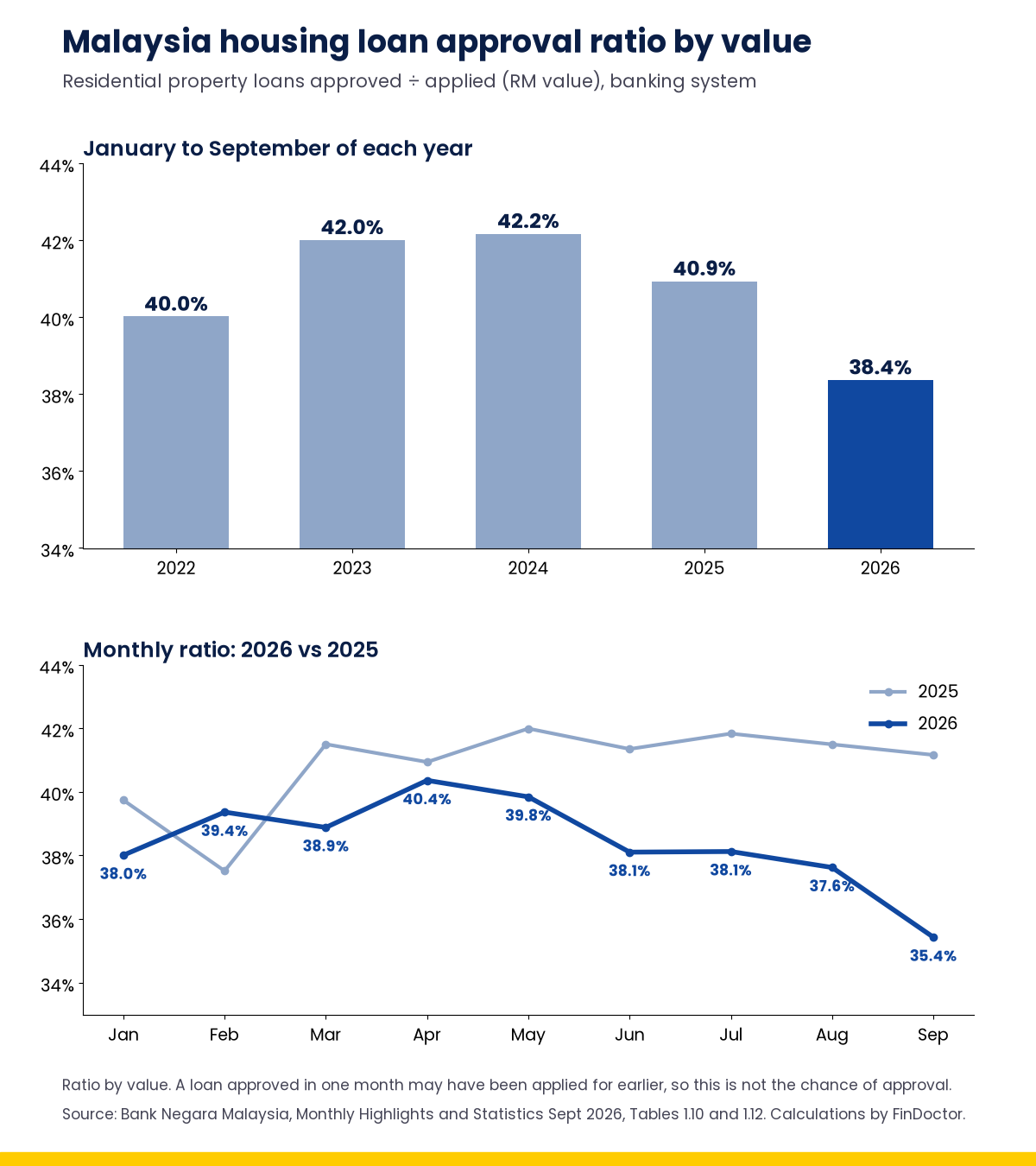
Read the numbers carefully. These are ratios by value, not by number of applications. A loan approved in one month may have been applied for in an earlier month, and one buyer may apply to several banks for the same property. So the approval ratio is not your chance of approval. It shows how much lending banks are approving compared with how much is being asked for.
The New Straits Times reported on 10 November 2026 that housing loan approval rates fell to 38.36% in September 2026, compared with a range of 40 to 41% between 2022 and 2025. That figure matches our year-to-date ratio for January to September 2026.
Why are banks approving fewer home loans?
Demand is rising faster than approvals. Residential loan applications for January to September 2026 were about 2.6% higher than a year earlier, while approvals were about 3.8% lower. The sources point to three reasons:
- Banks are more selective. NST reported that banks are becoming increasingly selective in approving housing loans.
- Income that is hard to verify. According to NST, self-employed people and gig workers often struggle to get conventional financing because they cannot show a fixed salary or formal payslips, even when their income is substantial.
- Property type. NST also reported that banks are more cautious about high-end serviced apartments with low occupancy that rely on short-term rentals.
Credit is still growing overall. BNM reported household loan growth of 5.3% in September 2026 (August 2026: 5.2%). Interest rates are steady for now: BNM kept the Overnight Policy Rate (OPR) at 2.75% on 5 November 2026, and the next Monetary Policy Committee meeting is on 21 January 2027.
Why do housing loans get rejected?
Most rejections come down to the 5Cs banks assess: your credit history, the property as collateral, your repayment capacity or DSR, your savings and the bank’s own conditions. We explain each one in our guide to how banks assess a home loan application using the 5Cs. If one bank says no, BNM notes that other banks may view your application differently because each has its own lending policy.
How do I check my loan readiness before applying?
- Work out your DSR. Add up your monthly commitments, including the new instalment, and compare them with your income. There is no single DSR limit. Each bank sets its own threshold, so run your numbers in the FinDoctor Loan and DSR Calculator first.
- Check your CCRIS and CTOS records. Banks look at your repayment conduct. BNM’s CCRIS report shows outstanding accounts, pending applications and applications approved in the last 12 months. Rejected applications are not shown. See how FinDoctor, CCRIS and CTOS reports compare.
- Prepare your documents. Have recent payslips, bank statements, EPF statements and tax records ready, plus the property details. Requirements vary by bank.
- Space out applications. Pending applications appear in CCRIS, so plan which banks to approach rather than applying everywhere at once. Our six steps to get a loan approved in Malaysia covers the basics.
If you are buying your first home, the proposed Budget 2027 stamp duty relief may reduce your upfront costs, but it only helps once your loan is approved. Read Budget 2027 stamp duty for first homes.
Self-employed or a gig worker? What banks usually ask for
NST’s report highlights that the lack of payslips is a common hurdle. Banks usually want to see income that is regular and documented, for example:
- Several months of business or personal bank statements showing steady deposits
- Income tax returns and assessment records
- Business registration and financial statements or management accounts
- EPF contributions, if you make voluntary contributions
Exact requirements differ by bank. NST also noted that the government-backed Skim Jaminan Kredit Perumahan (SJKP) is intended as an alternative for people without fixed incomes. Our guide for self-employed borrowers who need a loan explains how to present your income.
How FinDoctor helps
Check before you apply. FinDoctor’s free Lite Report shows how your credit profile matches against 20 Malaysian banks and the DSR Calculator shows your debt service ratio. FinDoctor is not a lender. Approval is always the bank’s decision.
When you are ready, compare home loan options. For deeper guidance, the Pro Report costs RM50 and a one-to-one Pro Advisory session costs RM650.
Frequently asked questions
What is the housing loan approval rate in Malaysia in 2026?
BNM data shows banks approved about 38.4% of the value of residential property loans applied for from January to September 2026. That is down from about 40.9% in the same period of 2025.
Is the approval ratio my chance of getting a home loan?
No. It is a ratio by value for the whole banking system and a loan approved in one month may have been applied for earlier. Your own outcome depends on each bank’s view of your income and DSR and credit record.
What DSR do banks accept for a home loan?
There is no single figure. Each bank sets its own debt service ratio threshold and it can differ by income level and loan type. Check your numbers in a DSR calculator before you apply.
Does a rejected loan application show in my CCRIS report?
No. BNM says rejected credit applications are not shown in CCRIS reports. Pending applications and applications approved in the last 12 months do appear.
What is the OPR now and when is the next decision?
Bank Negara Malaysia kept the OPR at 2.75% on 5 November 2026. The next Monetary Policy Committee meeting is on 21 January 2027.
Sources
- Bank Negara Malaysia, Monthly Highlights and Statistics, September 2026, Tables 1.10 (loans applied by purpose) and 1.12 (loans approved by purpose). Approval ratios calculated by FinDoctor.
- Bank Negara Malaysia, Monthly Highlights, September 2026 (household loan growth)
- Bank Negara Malaysia, Monetary Policy Statement, 5 November 2026 (OPR and 2027 MPC schedule)
- Bank Negara Malaysia, FAQ on CCRIS (accessed 20 November 2026)
- New Straits Times, report on falling housing loan approvals, 10 November 2026
This article is general information, not financial advice.
Last updated: 20 November 2026

Apply Now to Get Started!
Get your personalised recommendations on which bank offers the best interest rates for you!
FinDoctor Money Tips

· FinDoc Editorial Team
SME SRF Loan 2026: Who Qualifies, Rates and 2027 SME Tax
BNM’s SME Stabilisation Relief Facility offers viable SMEs hit by the Middle East conflict up to RM750,000 in working capital at up to 3.75% a year with no collateral until 30 June 2027. Here is who qualifies, how to apply and what the Budget 2027 SME tax proposals mean.

· FinDoc Editorial Team
Open Finance Malaysia: What BNM’s New Rules Mean for You
BNM’s Open Finance Policy Document lets you share your bank, e-money and card data between financial institutions, only with your consent. Here is the 2028 to 2030 rollout and what it could mean for loan applications.